
September 14, 2026
What six restaurant owners want from a loyalty program
Six owners, three places: Delhi, Gainesville in Florida, Alameda in California. Two countries, and restaurants with nothing else in common. I went in with questions about what a loyalty program should do. I came out with a list of things it must not do, and across six conversations the lists were nearly identical.
The first owner handed me most of it in a single answer:
"My staff is non tech and they are busy, they can't hold a new device and I can't provide training to learn new system. Hence a solution that doesn't add extra step, no new device or app, and no training."
Three prohibitions and a constraint, offered before I had asked for anything.
The part nobody argued about
Two things were never in question. Owners want the people who came once to come back. They want some way to say "it's quiet tonight" to those people without buying an ad.
I had prepared an argument for the first one and never used it. Nobody needs persuading that repeat customers are worth more than new ones. That is not where the difficulty is.
Not a paper card
Everyone knows they get lost. The reason owners actually give is different: a punch card tells the owner nothing at all. Somebody arrives with nine stamps and there is no way to know when the first eight happened, whether it was the same person each time, or how many other half-filled cards are sitting in wallets around the neighborhood. You cannot look at a stack of loyalty cards and learn anything about your own business, because the cards are not with you. They are out there, and one of them belongs to a regular's cousin who owns a similar pen.
Not an app
This one comes fastest, because every owner is also a diner.
Nobody is going to install an app for a sandwich shop. They are certainly not installing a second one for the coffee place next door. The owners who raised this did not present it as a preference. They said it the way you state a fact about weather.
I did not have a good answer at the time.
Not asking for a phone number at the counter
I had this one wrong, and the correction is the most useful thing I learned.
I assumed the objection was friction: an extra step, a slower line at the moment the queue is longest. That is real, but it is not what owners lead with. Here is what one of them said:
"Many diners are not comfortable in giving their phone number because they think that we will start spamming them."
The barrier is not effort. It is distrust, and the distrust is earned. Diners have handed over their number at enough counters to know what usually follows.
Which puts the owner in an unpleasant position. They want a way to reach their regulars, and the standard way of getting it makes those regulars trust them slightly less on the way out. Every sign-up form at a till is a small withdrawal from the relationship the loyalty program exists to build. The owners who mentioned this were not protecting their diners from spam in the abstract. They were protecting them from the program I was proposing.
Not another device
A tablet needs counter space that is not there. It needs charging. It needs somebody to notice when it has stopped working, which will happen on a Friday, and the person who notices will be the one least able to do anything about it.
Not something the staff have to learn
The first quote covers this, and turnover is the whole argument behind it. Somebody on every shift was not there last month. Nobody is scheduling a training session for a punch card. Anything that needs explaining works in month one and has quietly stopped working by month four, and the owner finds out when a regular asks why nobody scanned their thing any more.
Notice what "no training" actually demands. It is not a simpler interface. It is no step for staff at all, because any step is a step somebody has to be told about.
The POS, which was the one exception
This is the only place where an owner wanted more from me rather than less, and they talked themselves out of it inside one sentence:
"Integrating with our POS would be a good idea but not sure all POS would allow you to integrate."
The doubt is well placed. POS integration is not a feature you build once. It is a partnership per vendor, negotiated separately, and it means the loyalty program only works at restaurants whose till happens to be on the list.
But the objection that mattered more was not about engineering at all. It was about leverage.
Restaurants change their POS. Prices go up, support gets worse, a better system turns up, the business changes shape. If the loyalty program lives inside the till, then changing tills means starting the loyalty program again from nothing. The stamps, the history, the list of who your regulars are: all of it belonging to the company you are trying to leave. Which means you cannot credibly threaten to leave. Which means the price next year is whatever they decide it is.
The thing that takes your money should not also be the thing holding your customers. Those are two different relationships, and only one of them is supposed to be difficult to end.
So the answer is not a better integration. It is no integration, and a loyalty program that outlives whichever till is on the counter this year.
The expensive version of this lesson
I did not need six owners to tell me how fast a POS conversation goes wrong. We had already run into it, before any of these interviews, and at some cost.
We built table ordering. A diner scans a code, browses the menu, adds to a cart, and the order lands on a screen for staff to confirm. I thought it was the strongest thing we had.
What a restaurant manager hears when in-app ordering appears on a screen is "this replaces my POS." Not sometimes. It became reliable enough that we stopped treating it as a misunderstanding to correct and started treating it as information. It cost us the conversation every time, and the conversation was about something else entirely.
We removed the whole ordering surface on 6 August. Not deferred behind a flag. Deleted, along with the cart and the table-level codes that only existed to feed it.
What is left
Take away the card, the app, the sign-up at the till, the extra device, the training and the integration, and there is very little left to build.
That turned out to be the point. The list was not a set of objections to be worked around on the way to a product. It was the specification, and six people in two countries had handed it over without being asked for one.
What we built to fit it
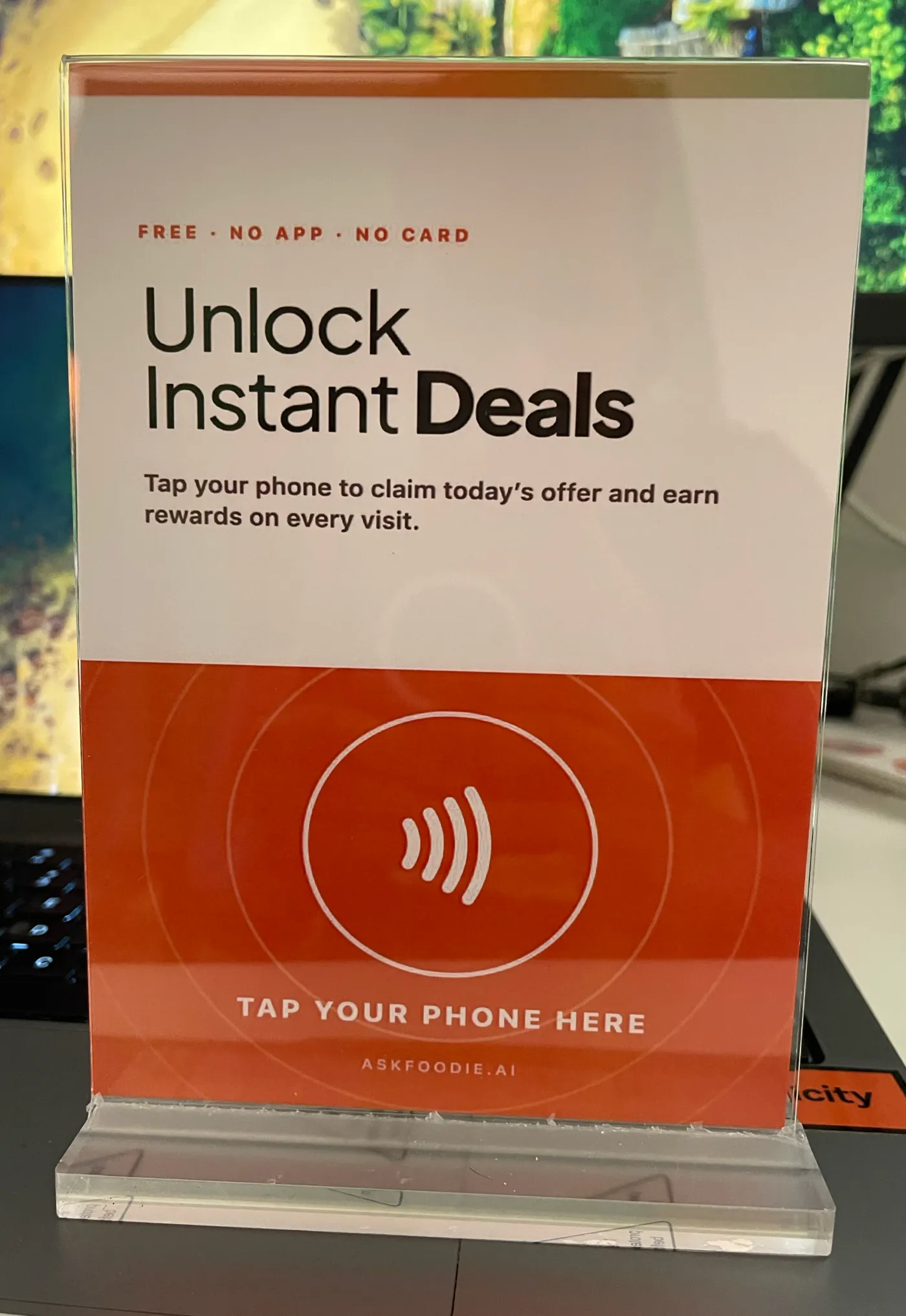
A diner taps their phone against a printed card in a small acrylic stand by the till, on the way out. The punch lands. Staff do nothing, and there is nothing for them to learn, because there is no step for them in it. Nobody installs anything. Nothing touches the till.
That is the entire mechanism. It took an embarrassingly long time to get down to something this small.
What I still don't know
Six is six. It is enough to notice that Delhi and Alameda gave me the same list, which surprised me, and nowhere near enough to know what the seventh owner says.
None of this has been through a real Saturday rush, and a counter at 8pm on Saturday is a different physical object than the same counter on a Wednesday afternoon. I do not know what the tenth visit looks like, once the novelty of the tap is gone and it is just a thing you do before you leave.
And I am not certain the no-training claim survives its first real test. That test is not the install. It is the new hire in month four who was not there when we set it up, and who nobody remembered to mention it to.
If you run a place in Alameda and want to find out alongside me, give me your menu and I will have it live on your own page before I leave.